Standard clause
My mother told a family member she was certain I would kill myself. She didn't call me. She didn't text. She reached for a story about a notary that wasn't even true.
On narcissistic mothers, suicide, and the weaponisation of a will.
I called my parents for support. That was the mistake.
I was going through a difficult period. Multiple things converging at once. Stress, loss, the kind of pressure that strips your capacity down to nothing. Two months earlier, my father had been admitted to hospital with heart failure. During his admission, I discovered he has an alcohol problem. I was processing both of those - the medical crisis and the revelation underneath it - while managing my own recovery, my own work, my own life.
On a Sunday, I called them for what any adult child looks for when life gets heavy: the sound of someone who loves you saying I'm sorry you're going through this. What do you need?
Instead of support, I received a directive.
The day after that call, my father texted me. He asked how I was doing. A part of me was happy because how kind of him to check in on me. That lasted for a mere 2 seconds. He pressed me. Twice. The same question repeated, checking whether I'd done what they wanted. Whether I'd obeyed.
I answered honestly. And then I went quiet because I could feel the shape of what was coming. The question wasn't concern. It was an audit.
The following Sunday, my mother called.
Her opening move was accusation. I hadn't phoned in a week. She had the right to know how I was doing. I had no idea what they had been going through. I hadn't asked about the notary appointment.
I hadn't asked because I'd read the documents. I'd edited them and talked about it with my father. Multiple times. There was nothing to ask. What should I have said? Was the ink blue or black?
I referred her to the texts I'd sent my father. She said she hadn't read them.
Later in the same conversation, five minutes, maybe ten, she referenced something from those texts. The ones she hadn't read. I caught it. She didn't flinch. And something in me shifted from frustration to a colder kind of clarity: she was lying, she knew I knew she was lying, and it didn't matter. The lie wasn't a failure of memory. It was a tactic.
Later in the conversation she told me that there had been a problem with her passport at the notary. The kind of thing a parent might call their child about, saying: oh, you won't believe what happened. Instead, she stored it. And weaponised it as evidence of my neglect.
This is how it works. The narcissistic parent doesn't tell you what happened because telling you would be connection. They withhold it and then punish you for not asking or already knowing. The information becomes a weapon only once it's been denied.
She wanted to know how we would continue from here. You tell me, mother, because clearly I haven't lived up to your expectations. She replied she had no expectations of me. I was baffled. I stated that everything she came at me with was an expectation.
And that is when I set the boundary. Calmly. Clearly. I said: I am an adult. This is my life. Give me the space I need to make make my own choices, and carry my own consequences.
That was it. That was all I said.
A week later, I attended a funeral. It was held on a boat. I was standing at the railing when Coldplay's "Fix You" came on. My mother loves Coldplay. Despite everything, despite the call, the accusation, the lie about the texts, I recorded a video of the moment and sent it to her.
It was a gesture. Small, genuine. The kind of thing you do when one part of you still hopes the person on the other end is capable of receiving tenderness.
She saw it.
Three days later, she responded with a picture of a dog with puppies.
No acknowledgement of the video. No mention of the song, or the funeral, or the fact that her child had reached for her with something real. Just a picture of a dog. With puppies. As if my message hadn't existed. As if I hadn't.
I keep coming back to this moment. Not the rage, not the screaming, not the accusations: those I understand. Those have a lineage I can trace. But the dog with the puppies. That, I still don't fully understand. The casual obliteration of a genuine offering. The nonchalance. The absolute refusal to meet me where I was standing.
In the weeks that followed, my father had two medical appointments: a scan and a meeting with his cardiologist. I texted him before each one because I wanted him to know I was thinking of him.
I texted him the morning of the cardiologist appointment and asked if he'd update me as soon as he knew something. He said he would. I was concerned as the meeting would be about several tests and scans they had done on his heart to get a better picture of what was going on. During his admission earlier they found irregularities that couldn't be assessed on the spot.
I was on the phone that same evening with one of my family members. I hadn't heard anything from my parents yet. Neither had they. And then the phone rang. Not my phone. My family member's phone. It was my mother. It was bad news and they would call back later.
They did, and the family member live texted me during the conversation. I couldn't access any feelings in that moment. Dissociation, my strongest armour, back to protect me from the overwhelm in that moment.
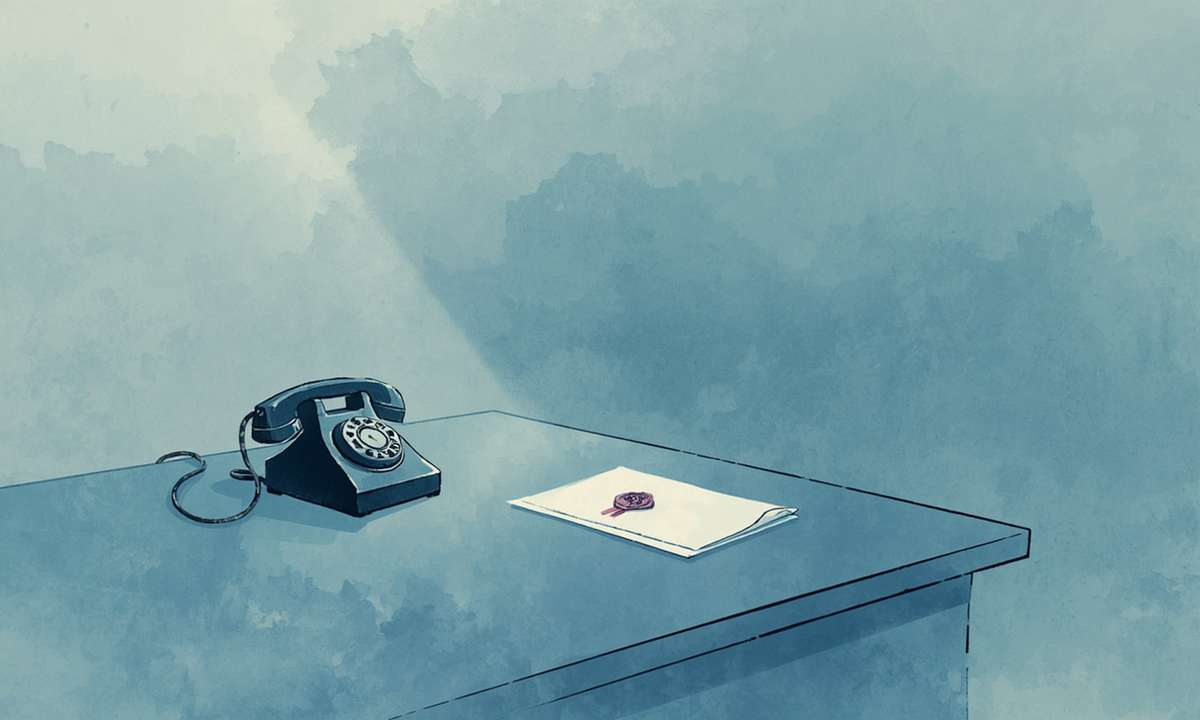
My father waited a day and a half. He delivered a life-threatening diagnosis over WhatsApp. A text message. And all the while I knew. I knew he'd had the results, I knew he'd shared them with others first, and I knew he'd chosen to make me wait.
I texted back very measured, appropriate, matching the register he'd set. I'm so sorry to hear that. That's not nothing. I'm in shock.
He read it and there was no further reply. No call. Not from me. Not from him. What would any normal parent do in a situation like this? Or with a message like that from their only child?
The message felt like a trap they craftily engineered for me.
That was the moment I made my decision.
Then came the phone calls. Not to me. To the family member they knew would relay everything back. The same family member who live texted me.
The catalogue of my failures arrived like dispatches from a war I hadn't agreed to fight. I was selfish. I didn't think about anyone. I never took other people's feelings into account. Their friend had shown up crying, had sent flowers — and I, their only child, had sent nothing. They had expected me on the doorstep and I hadn't come.
I live and work abroad. They encouraged it. Live your dreams, they said. How nice that there's FaceTime these days. And now the same distance they'd blessed was evidence of my indifference.
I show no interest in them. I always visit for just a couple of hours. My mother even made me soup fifteen years ago when I had pneumonia. Did I remember that? Had I considered what she had done for me? They are only good enough for me when I have a problem. They are completely done with my shit. I am almost forty.
My shit. Almost forty. Done.
My father told the family member I wouldn't have to bother showing up if something happened to him. If he ended up in hospital again. Or if he died.
They said they wanted to disown me. I heard that one before. Then pulled back because the felt that went too far. But they would spend all their money. Every last cent. So there would be nothing left for me to inherit.
Before we go on: what I mean by 'narcissistic supply'
In psychoanalytic terms, narcissistic supply is the attention, positive or negative, that the narcissistic personality requires to maintain its internal equilibrium. When supply is withdrawn, as it is when an adult child sets a boundary or refuses to comply, the narcissistic parent experiences what Kernberg described as narcissistic rage: a disproportionate, often explosive response to what feels like an existential threat to the self.
The boundary I set was minimal. I said: I am an adult. This is my life. Let me make my own choices.
That was enough. My words were not provocative but the act of self-differentiation, of existing as a separate person with separate judgment, is the one thing a narcissistic parent cannot tolerate. You are not experienced as a person. You are experienced as an extension. And when the extension moves independently, the system destabilises.
What follows is predictable. Rage first. Then triangulation: recruiting others to reinforce the narrative that you are the problem. Then escalation. And if none of that works, the most extreme form of punishment available: the weaponisation of your destruction.
And then my mother said something stopped me.
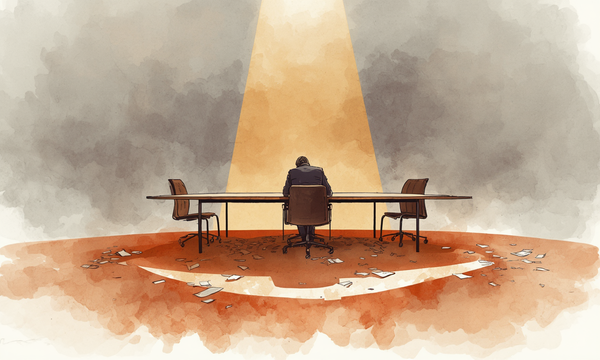
She told the family member that her will included a clause for the possibility that she might survive me. Because she knew - she was certain - that I was going to kill myself.
I should tell you something about my mother: she believes she is psychic. This is not a metaphor. She has always claimed intuitive abilities. The capacity to sense things, to feel what is coming, to know. She has used this throughout my life. She just knew when something was wrong. She could feel it when someone was lying. She predicted illness, predicted betrayal, predicted outcomes. When reality cooperated, she pointed to it as proof and asked you if you remembered when she told you this was going to happen. Even if she never had. and when reality didn't cooperate, the prediction was quietly retired.
The psychic claim is not a quirk. It is the instrument through which she elevates her opinions to the status of revelation. When she says she knows I will kill myself, she is not speculating. She is prophesying. And prophecy, unlike opinion, cannot be argued with.
I want to sit with that for a moment. Not analyse it. Just hold it in the room.
A mother. Telling a family member. That she is certain her child will die by suicide.
If you were so convinced as a mother I would do that, why wouldn't you be reaching out to ask if I'm okay? Not calling, not texting, not showing up at my door the way they demanded I show up at theirs. Not contacting a professional, a crisis line, anyone.
The certainty was dressed in the language she has always used: the psychic knowing, the intuition that cannot be questioned. And the audience was carefully chosen. Not me. Someone who would carry the message back to me. Because the purpose was never to help me. The purpose was to punish me. To say, through someone else's mouth: look what you've driven me to think about. Look what your boundaries will cause.
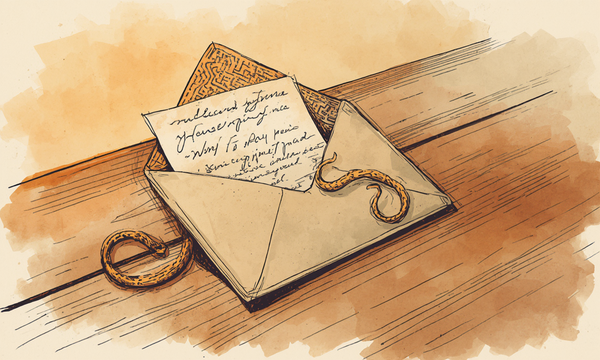
Here is what I know, because I had my own will drawn up years before they did: the clause she described is standard. Every competent notary includes a provision for the possibility that a beneficiary predeceases the testator. It is not a response to crisis. It is not something you request. It is a line in a template. It was already there.
She didn't request anything. She took a standard formality that already existed in the document and spun it into a prophecy of my death.
I don't know why she did it. I don't know if she knows why she did it. What I know is that she dressed a line in a template in the robes of her self-declared gift. A notarial formality became divine certainty. And she delivered it through a third party to maximise the damage.
This is what triangulation looks like at its most refined. The message is constructed for two audiences simultaneously: the family member hears a concerned mother preparing for the worst. I hear a threat wrapped in mourning clothes.
I need to say something carefully here, because the essay requires it and I owe it to the honesty of this space.
I did have suicidal ideation as a teenager. During the years of their abuse. She knows this. She was there. Or rather, she was the reason.
For her to take that history, the darkest chapter of a childhood she helped create, and use it as a prediction, a certainty, a story told to a family member: that is not concern. That is the final move in a game I didn't agree to play. It takes the worst thing they did to me and recasts it as the worst thing I will do to myself. It makes my pain her property. Even my death, in her framing, would be about her.
The mechanism underneath
In psychoanalytic terms, what my mother did is a form of projective identification with a specific cruelty. She took her own destructive impulse - the rage, the desire to annihilate the boundary I'd set - and projected it onto me as self-destruction. In her version, she isn't the one trying to destroy me. I am. She's simply preparing for the inevitable.
This is what I call narcissistic inversion. The aggressor becomes the mourner. The person who caused the wound becomes the one predicting you'll bleed out from it. And the prediction itself becomes a kind of curse - designed not to warn, but to destabilise. To plant the thought. To make you wonder, even for a second: is she right about me?
She isn't.
What Alice Miller described in The Drama of the Gifted Child is the architecture: the narcissistic parent cannot tolerate the child as a separate person with separate needs. The child exists to serve the parent's emotional equilibrium. When the child refuses that role — sets a boundary, makes an independent choice, exists on their own terms — the parent experiences it as annihilation.
What Melanie Klein described as projective identification is the weapon: the parent places their own disowned destructiveness into the child and reacts to it as if it originates there. My mother cannot hold her own rage, so she deposits it in me and points at it with alarm. Look. Look what he's going to do. The suicide isn't a fear. Was it a wish externalised as prophecy?
I've been through enough therapy to know what's happening. I've read enough Kernberg, enough Klein, enough Miller, enough Winnicott to name every mechanism in this dynamic. I can map the triangulation, trace the narcissistic supply chain, identify the projective identification with textbook precision.
And none of that protects you from what comes next. Or, in my case, what doesn't.
When I think about my mother telling someone she is certain I will kill myself (I'm writing this months after it actually happened) and that instead of reaching for me she reached for a story about a notary that wasn't even true - I feel nothing. No pain. No hurt. No sadness. No shock. No rage. Nothing. Is dissociation standing between me and whatever is underneath?
I don't have an answer for this yet. I feel feelings in other situations so I'm not shut down across the board. But here, on this specific point, about this specific person, there is nothing. Am I dissociating only on this? Am I just done? Have I disconnected completely from the woman who gave birth to me?
I don't know. And the not knowing might be the most honest thing in this essay. No amount of clinical language dissolves that. You can name every mechanism and still sit in a silence you can't explain.
What I chose
I chose no contact. Not low contact. Not the careful, managed distance I'd maintained throughout the years.
This time I didn't go back. This time I won't go back.
The grief of estrangement from a narcissistic parent is unlike any other grief because you're mourning someone who is still alive and was never fully there. You're not losing a relationship. You're finally admitting it was never what you needed it to be.
Winnicott wrote about the "good enough mother: the mother who doesn't need to be perfect, just present enough, responsive enough, real enough for the child to develop a true self. My mother was not that. And the false self I built to survive her - the accommodating, performing, rationalising self that kept me functional for decades - is the same false self I've been dismantling in therapy, piece by piece, year after year.
I'm not going no-contact as an act over revenge. It's self-preservation. It's the boundary she punished me for, held in place this time. Not with anger. With clarity.
What I'm still carrying
I don't want to end this piece with resolution, because there isn't any.
What there is: the knowledge that I will not call. That the next time life falls apart - and it will, because that's what life does - I will not reach for them. I will reach for the people who can hold what I bring without turning it into a weapon.
What there is: the understanding that her prediction says nothing about me and everything about her. That a standard clause in a will - one that was already there, that she never requested - became, in her telling, a prophecy. That she chose a fabricated story over a phone call.
What there is: the quiet, ongoing work of building a life that isn't organised around their approval or their rage. A life where my boundaries are not provocations. Where my choices are not betrayals. Where my existence is not a performance for an audience that was never going to clap.
I'm still here. Not because she predicted otherwise. Not to spite her. But because recovery, real recovery, is the ongoing refusal to let the people who hurt you define the terms of your survival.
I refuse.
If you're experiencing suicidal thoughts, please reach out to a crisis service in your country. You deserve support - real support, not the kind that comes with conditions.